
The global connector industry has just taken a heavy hit. On December 4, TE Connectivity (TE), the world’s leading connector manufacturer, issued a price adjustment notice to its global channel partners, announcing that starting January 5, 2026, prices across all product lines and all regions will be increased.
The announcement quickly sent ripples through the entire supply chain, highlighting the widespread pressure and challenges manufacturers are facing amid today’s inflationary environment.

A Unified Global Price Adjustment: Covering All Product Lines and All Regions
According to TE’s latest notice to its channel partners, this price adjustment is far from a regional trial—it is a globally synchronized and fully comprehensive move. The announcement specifies that the change applies to all authorized distributors, underscoring the company’s unified strategic approach to the global market.
The price hikes span an exceptionally broad range—from automotive-grade connectors to high-speed backplane solutions, and from spring-pin terminals to various categories of industrial connectors—covering virtually the entire TE product portfolio.
Distributor feedback indicates that the increases for certain categories fall between 5% and 12%, marking a moderately strong, structurally driven adjustment.
As a leading force in the connector sector, TE Connectivity supplies products that are deeply embedded across key industries including automotive, telecommunications, industrial equipment, and aerospace. With this across-the-board price increase, the ripple effects will be widespread: from automotive manufacturing to data-center buildouts, and from industrial automation to consumer electronics, multiple downstream industries will now be compelled to reassess and recalibrate their cost structures.
An Inevitable Move Amid Mounting Pressures: Rising Costs and Structural Shifts in Demand
TE’s latest price adjustment is the inevitable outcome of multiple converging pressures.
Rising raw-material costs remain the primary driver. Since 2025, copper prices have climbed into a markedly higher trading range. As one of the core materials in connector manufacturing, the surge in copper prices has directly escalated production costs.
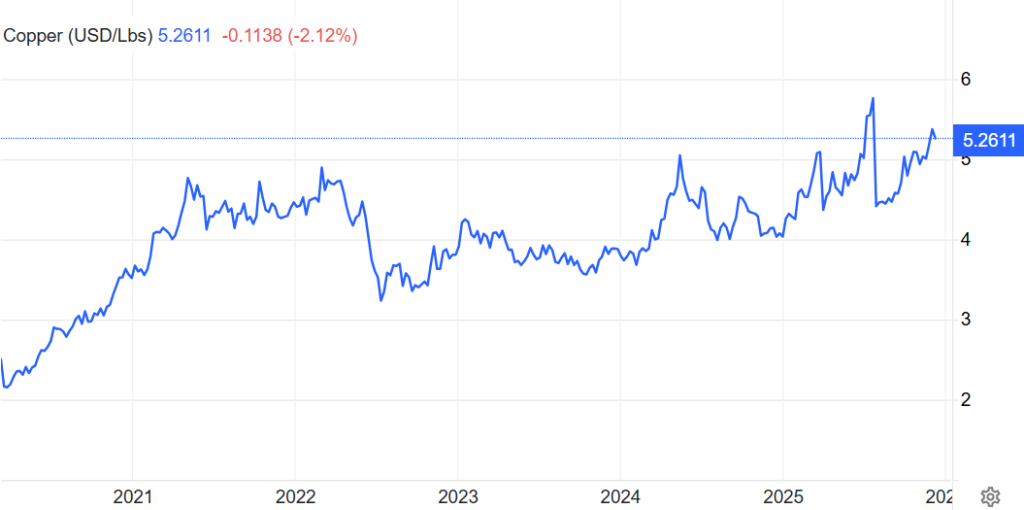
A research report from CITIC Securities notes that USD 12,000 is likely to become the new baseline for copper, offering a quantifiable reference point for the mounting cost pressure across the connector industry
Global inflation pressures have had an especially pronounced impact on multinational manufacturers that rely on large-scale production. In an inflationary environment, the cumulative effect of rising costs becomes magnified—energy, logistics, and labor expenses have all trended upward, ultimately converging into a burden that companies can no longer easily absorb.
At the same time, structurally strong demand has opened the space for price increases from another angle. With the rapid expansion of electric vehicles, 5G communications, and industrial automation, demand for high-performance connectors continues to climb. Driven particularly by automotive electrification and the ongoing upgrade of data centers, the high-end connector market is experiencing a clear supply-demand imbalance, further reinforcing the rationale for the upward pricing shift.
TE’s decision to implement another across-the-board price increase, following several previous rounds of structural adjustments, reflects the company’s challenging balancing act between rising cost pressures and market competitiveness.
Supply Chain Ripple Effects: Cost Transmission from Upstream to End Products
TE’s price hike is set to trigger an inevitable chain reaction throughout the supply chain.
In the short term, the most immediate impact will be seen in the costs of automotive wiring harnesses, industrial equipment, and server systems. As a critical component in these products, the rising price of connectors will directly push up downstream manufacturing costs.
The automotive sector, in particular, faces a new wave of cost pressures—especially traditional automakers and emerging EV manufacturers that are accelerating electrification. Connectors play a significantly larger role in both volume and value in electric vehicles compared to conventional internal-combustion cars. This latest price adjustment could slow the decline in unit costs for certain models and may even influence end-market pricing strategies.
Data center and telecom equipment manufacturers are also set to feel the pressure. Price increases for critical components, such as high-speed backplane connectors, will directly raise the manufacturing costs of servers, switches, and other devices. Against the backdrop of continuously growing demand for computing power, this cost transmission could ultimately affect the pace of digital transformation.
The industrial automation sector, another key application market for connectors, is equally impacted. During this critical phase of smart manufacturing upgrades, rising equipment costs could slow down the automation initiatives of some companies.

Industry Competitive Landscape Could Be Reshaped
As the sector leader, TE’s pricing move is likely to prompt follow-on actions from other players in the industry. Global connector manufacturers such as Amphenol, Molex, and Yazaki are facing similar cost pressures, making it possible that they will announce comparable price adjustments in the coming months.
This round of price increases could accelerate consolidation in the connector industry. Smaller players with weaker cost-control capabilities will face greater pressure, while technologically advanced companies with strong supply chain management may seize the opportunity to expand their market share.
At the same time, the pricing pressure could spur technological innovation. Material substitution, process optimization, and design innovation are likely to become key strategies for mitigating rising costs. For example, efforts to find alternatives to copper, develop more efficient manufacturing processes, and design higher-integrated connector solutions could gain momentum under the current cost pressures.
Long-Term Outlook: Structural Adjustments and Value Chain Restructuring
TE’s global price increase is more than just a pricing adjustment—it could mark the beginning of a broader value chain restructuring in the connector industry, and potentially across the entire manufacturing sector.
In the short term, downstream companies will face cost-control challenges and may need to reassess their supply chain strategies, including diversifying suppliers, adjusting inventory policies, and optimizing product designs.
In the medium term, this wave of cost pressure may drive manufacturing toward greater efficiency and intelligence. Industrial 4.0 technologies, smart manufacturing, and digital supply chain management will become increasingly important, helping companies navigate cost fluctuations and market changes.
In the long term, trends toward regionalization and nearshoring of global supply chains may accelerate. Driven by geopolitical factors and cost considerations, manufacturers are likely to prioritize supply chain resilience and controllability over simply pursuing the lowest costs.
TE Connectivity’s across-the-board price increase acts as a mirror reflecting the challenges faced by global manufacturing under inflationary pressures, raw material volatility, and shifting demand. For every participant in the supply chain, this represents not only a challenge but also an opportunity to reshape competitiveness and optimize the value chain. In a landscape where cost pressures are becoming the new normal, innovation, supply chain management, and cost-control capabilities will be more critical than ever to determining a company’s survival and growth.
As the January 5, 2026, price adjustment date approaches, the global connector industry stands at a crossroads of transformation—and the effects of this change will extend far beyond connectors themselves, permeating every corner of a modern economy driven by digitalization, electrification, and automation.